
How Does Sleep Affect Spinal Health?
How Does Sleep Affect Spinal Health?
By: Hannah Burnett, Andy Park DC, DNSP
It’s no secret that getting a “good night’s sleep” is important for your overall health and well-being. Both mentally and physically, your body needs time to rest, recover, and reset in order to keep everything functioning at its best. Sometimes you may wake up and notice a stiff neck or slight back pain; and many people dismiss this problem by blaming it on lack of sleep or sleeping in a weird position. However, sleep and spinal health are more interconnected than most people realize. The act of sleeping allows time for your spine to decompress from holding up your body all day. Additionally, the position(s) you sleep in can determine whether your spine is supported or causing your alignment more harm than good.
What happens when you get quality sleep?
As mentioned above, your spine relies on sleep to recover. The vertebrae and intervertebral discs that make up your spine use the time to rehydrate with fluids and repair any wear/tear from the day. During sleep, the body releases growth hormones that allow for tissue repair; and in this context, the muscles and tissues in the back/neck that surround the spine benefit the most. Any chronic back or neck pain that was already occurring during the day can be reduced from quality sleep because the inflammation decreases. These processes all depend on the duration and quality of sleep.
Most adults are recommended to get 7-9 hours of sleep at night, and if you are recovering from sickness or an injury you may need even longer. It can sometimes be hard to get the optimal hours of sleep every night, especially if you are suffering from sleep disorders like insomnia or sleep apnea. Poor sleep quality is not only a detriment to your spine’s restorative processes, but it can also increase pain/stiffness in the body while exacerbating any existing chronic issues. The more solid sleep you can get in the night, the more likely you are to wake up with a happy spine and less discomfort in your back or neck.
Why do sleeping positions matter?
Staying mindful about posture while you’re sleeping sounds like a difficult challenge. But staying proactive and making some changes before you go to sleep could benefit your spine greatly. The effect sleep has on your spinal health is directly dependent on what position you typically sleep in. No one position is necessarily better than the other, but there are modifications that can be made with pillow positioning that can support your spine better. Here are three different options:
Back sleeping: Sleeping on your back can help keep the spine in a neutral position and distribute the weight more evenly.
Having one pillow for your head and another placed under the knees could help reduce any strain on the lower back.
Side sleeping: Side sleeping is relatively common and often preferred for its comfortability.
Having a thicker pillow for your head (to keep it level with the spine) and another placed between the knees will help keep the hips and lower back aligned.
Stomach sleeping: Sleeping on the stomach puts the most pressure on your neck and back as it doesn’t necessarily allow for the spine to lay in its natural curve.
If this positioning is causing neck or back pain, you could try having a pillow for your head as well as a thin pillow under your pelvis/lower abdomen.
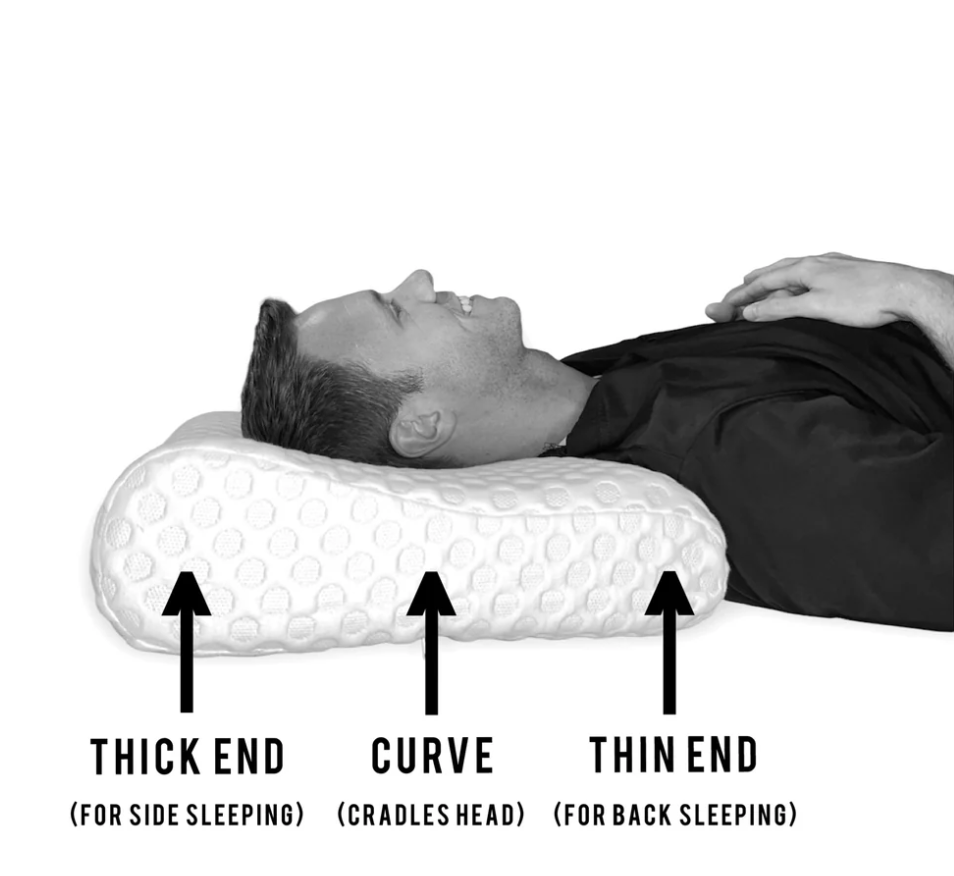
If you are having trouble getting comfortable when trying to sleep, it could have to do with your mattress or your pillow. If your mattress is too hard or too soft, your spine isn’t supported properly and this can put unintentional strain on your back muscles. Using the wrong pillow can result in added pressure to your neck and uncomfortable positioning. We have an alternative pillow option here at Northcenter Healthcare that may help if you’re dealing with neck and back discomfort during the night. What makes this pillow different from any other average pillow would be its density and structure. There is a thicker end of the pillow which is meant for side sleepers, and a lower/thinner end of the pillow meant for back sleepers. The curve on both of these ends fit well to the natural curve of the neck without adding too much pressure or force to the head. This pillow may be an option to consider as it can help give you better support and positioning during sleep. If you have any more questions about how your sleep is affecting your spinal health or are curious about purchasing a pillow, feel free to bring it up at your next appointment!
References:
Dr. Horine Chiropractic. (n.d.). How sleep positions & pillows affect neck & back pain. https://drhorine.com/how-sleep-positions-pillows-affect-neck-back-pain/
National Spine Health Foundation. (n.d.). Sleeping and the spine. https://spinehealth.org/sleeping-and-the-spine/
Spinal Recovery Center. (n.d.). How sleep affects your spinal health. https://spinalrecoverycenter.com/info/how-sleep-affects-your-spinal-health/
Van Looveren, E., Bilteryst., Munneke, W., Cagnie, B., Ickmans, K., Mairesse, O., Malfliet, A., De Baets, L., Nijs, J., Goubert, D., Danneels, L., Moens, M., & Meeus, M. (2021). The association between sleep and chronic spinal pain: A systematic review from the last decade. Journal of Clinical Medicine, 10(17), 3836. https://doi.org/10.3390/jcm10173836