
Your Shoes Are Doing Too Much – The Case for Minimalist Footwear
Are Minimalist Shoes Good for your feet?
By: Arianna Tsengouras, Chiropractic Intern
What is the most important factor when you look for new athletic shoes? Is it the style? The
color? The fit? The support? The cushion? There are many elements that drive us to pick the
shoes we wear for hours a day. But, what if I told you that while most athletic shoes claim to
support you, they simultaneously rob you of the very support you want to build. Let’s use an
analogy that Dr. Park uses, take a neck injury for example. If you injure your neck and you put a
brace on it, will it help you recover? Yes. But, what happens if you continue to use the brace
when you no longer need it? It won’t hurt you per se, but then you become over reliant on it. The
same thing happens with shoes that advertise “support”, “stability”, etc. We rely on our shoes to
support our feet rather than training our feet to support themselves. So how did we go from
walking barefoot to motion controlling trainers and is it time to rethink everything?
The History of Minimalist Shoes
Minimalist shoes may seem like a new trend, but they have deep roots. The first shoes were
created around 10,000 years ago for the purpose of protecting the bottom of our feet. Through
centuries of experimentation athletic shoes evolved from woven bark into the rubber and canvas
we know today. These shoes can also be categorized into one of three categories: increased
cushion, increased stability or increased motion control1.
Each of these types tried to address a specific “issue”. While increased cushion shoes were created for people who have increased arches in their feet, motion control shoes were created for the opposite, those with “flat feet” and for those with a “neutral foot” stability shoes were created. All of these shoes have one common goal: injury prevention. However, these shoes changed the actual way we walk which caused us
to become prone to other injuries instead. These days, people are starting to ask more questions
about minimalist shoes and if we should return to using them more.
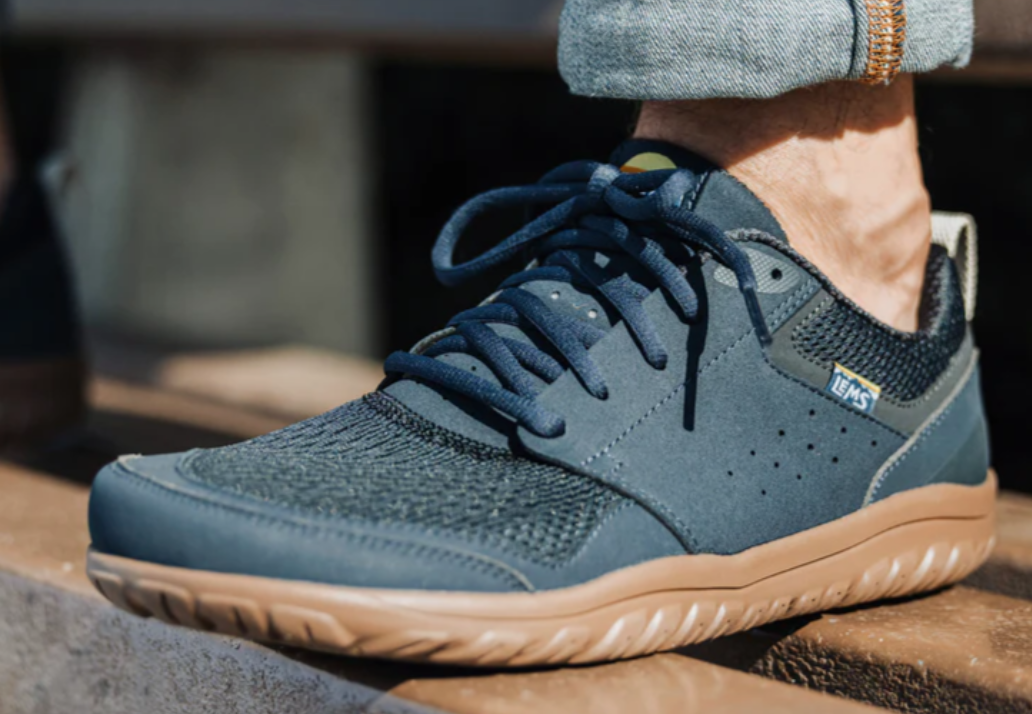
A minimalist shoe is described as having less cushioning, stability, heel to toe drop, stack height
(the distance from your foot to the ground) and a bigger toe box. These shoes aim to mimic
walking barefoot and encourage our foot muscles to work on their own all while still protecting
our feet. Research has been conducted on the effectiveness of using minimalist shoes and injury
prevention and you might be surprised. Overall studies found that our foot muscles increased in
function especially in the forefoot region (the ball of the foot) leading to increased strength and
agility when using minimalist shoes2.
This is likely due to the fact that normal running shoes
cause what is called a rear foot strike or a heel strike which does not allow us to absorb shock
from walking and running efficiently. In contrast, minimalist shoes cause a fore foot strike which
is when the ball of your foot and your toes contact the ground first. When this is allowed, we
change the way our body loads our feet, how our joints move and the order in which our muscles
in our feet activate. This chain of events leads to a decreased risk of repetitive stress injuries like
plantar fasciitis, patellofemoral pain syndrome and achilles tendinopathy3.
Just as athletic shoes have evolved over time, so have minimalist shoes. Aside from the basic shoe, some minimalistshoe companies have expanded into minimalist focused basketball, pickleball, sandals and boot
styles.
Research suggests that the benefits of minimalist shoes may start earlier than most people expect
– as early as primary school. One article discussed the use of minimalist shoes for primary
school students to assess if there would be more activation of the intrinsic foot muscles (the
muscles responsible for the arch of the foot, gripping, spreading and balancing of the feet) and
therefore the integrity of the arches of their feet. They found that wearing minimalist shoes for
just 3 days improved arch height – a sign of stronger intrinsic foot muscles. This suggests that
even some use during childhood can meaningfully shape how a child’s feet develop4
. So whether
you’re a parent considering your child’s next sneaker or someone with nagging foot pain, the
same question comes up: should I make the switch?
Should I start using minimalist shoes?
The research supporting minimalist shoes is promising – but they aren’t for everyone. If you are
someone who runs constantly on streets, you work all day on your feet or you stand on concrete
for hours at a time, you may want a shoe with more cushion for comfort. Also, if you have been
told you have a structural deformity of the feet, neuropathy or have significant mobility or
balance limitations, minimalist shoes may not be the best option for you. However, if you have
healthy feet, are active and want to give your feet an opportunity to strengthen and function as
they were designed to, minimalist shoes may be for you. Ultimately, this is a discussion you can
have with a healthcare professional to make the best decision together. If you do decide to give
minimalist shoes a try, start slow – your feet need time to adapt. Sometimes you may feel muscle
fatigue in your feet and calves; this is completely normal and a sign that your intrinsic foot
muscles are working more than they have been. You can start by wearing them for an hour or
two a day and slowly increase the time you spend in them until they become your everyday shoe
or settle into whatever balance works for your lifestyle.
As a proud affiliate of Lems, if you are looking to give minimalist shoes a try, check them out.
Their shoes feature a wide toe box, low heel-to-toe drop and minimal stack height – everything
we’ve discussed – are great quality and stylish enough for everyday wear. Click here to check
out some options! Small changes in what you wear every day can have a meaningful impact on
how your feet – and your whole body – feel and function long term.
Do this next!
Share this Article with a Friend or Family member who might be interested in the topic!
Call our office TODAY at (773) 296-2766 to book a New Patient appointment or schedule a free chat (discovery call) with us to see if we can help you out or if you have other questions about care or costs. You can book either by clicking here!
Keep an eye out for our next article!
References:
1. Davis, IS. The Re-emergence of the Minimal Running Shoe. Journal of Orthopaedic &
Sports Physical Therapy. 2014;44(10):775-784.
doi:https://doi.org/10.2519/jospt.2014.55212. Rodríguez-Longobardo C, Gómez-Ruano MÁ, Canosa-Carro L. Effects of Barefoot and
Minimalist Footwear Strength-Oriented Training on Foot Structure and Function in
Athletic Populations: A Systematic Review. Journal of Clinical Medicine. 2025,; 14
(21):7629. doi:https://doi.org/10.3390/jcm14217629
3. DesRochers J, Chow A, Rubin D, Raja A. Effect of gait retraining in minimalist footwear
or barefoot on running footstrike and cadence: a systematic review. Research in Sports
Medicine. Published online August 5, 2025:1-13.
doi:https://doi.org/10.1080/15438627.2025.2543094
4. Fong Yan A, Quinlan S, Cheung RTH. Minimalist school shoes improve intrinsic foot
muscle size, strength and arch integrity among primary school students. Journal of Sports
Sciences. 2024;42(12):1157-1163. doi:http://doi.org/10.1080/02640414.2024.2386213